Launch offer — valid today only

📄 Digital book in PDF · read it on your phone or print it

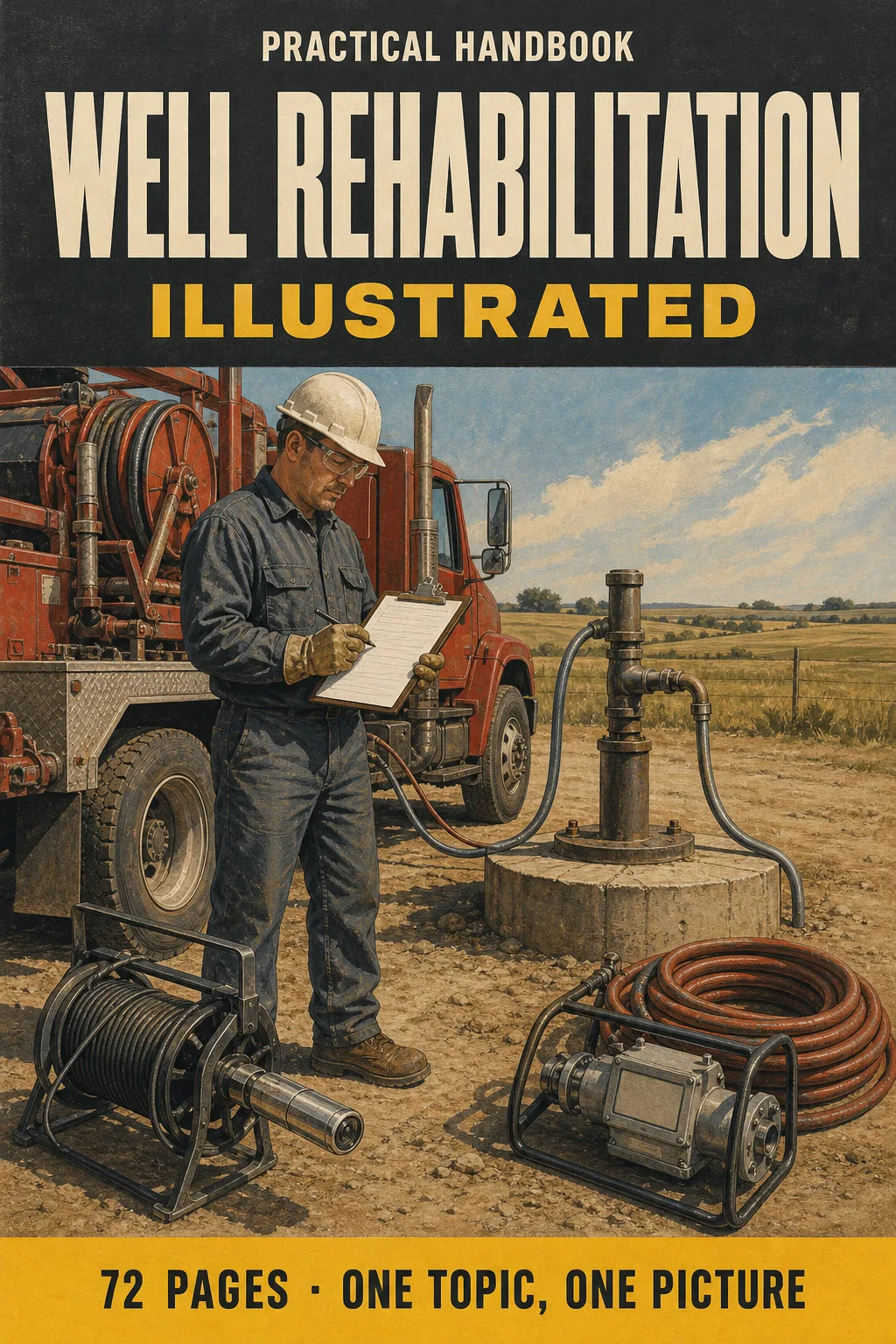
Well Rehabilitation, From Lost Yield to the After Test, in Drawings The Same 5 Steps on Every Job

Yield dropped from 10 gpm to 4? Red water, rotten-egg smell? Find out if it's the pump, bacteria, scale or the well itself, and whether to rehab or redrill. One topic per page: the drawing first, then the numbers in gpm, feet, gallons and ppm. 72 illustrated pages.

SHOW ME THE 5 STEPS, DRAWN

🔒 Secure checkout · PDF by email · 30-day guarantee

Every topic, its own pageEach rehab step drawn in a well cutaway, with the explanation right beside it
72 illustrated pages9 parts, from the well in cutaway to what to verify with your state
Up-to-date sourcesAWWA A100, US EPA private well guidance and state well codes
PDF by emailFormat

Look Inside the Book

Every page has one big drawing and a box with the numbers and steps you need to know:

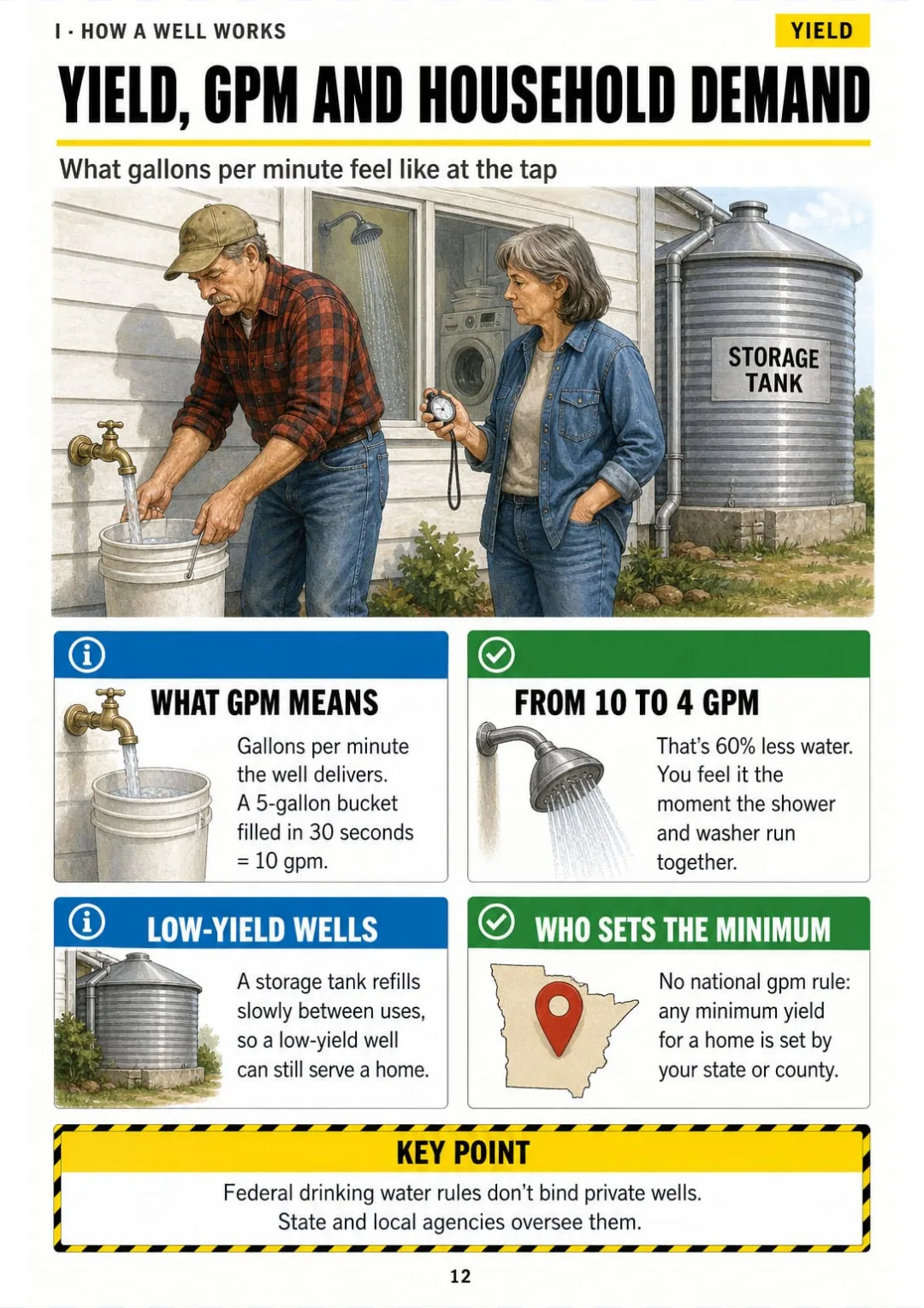
A 5-gallon bucket filled in 30 seconds is 10 gpm; dropping to 4 gpm is 60% less.
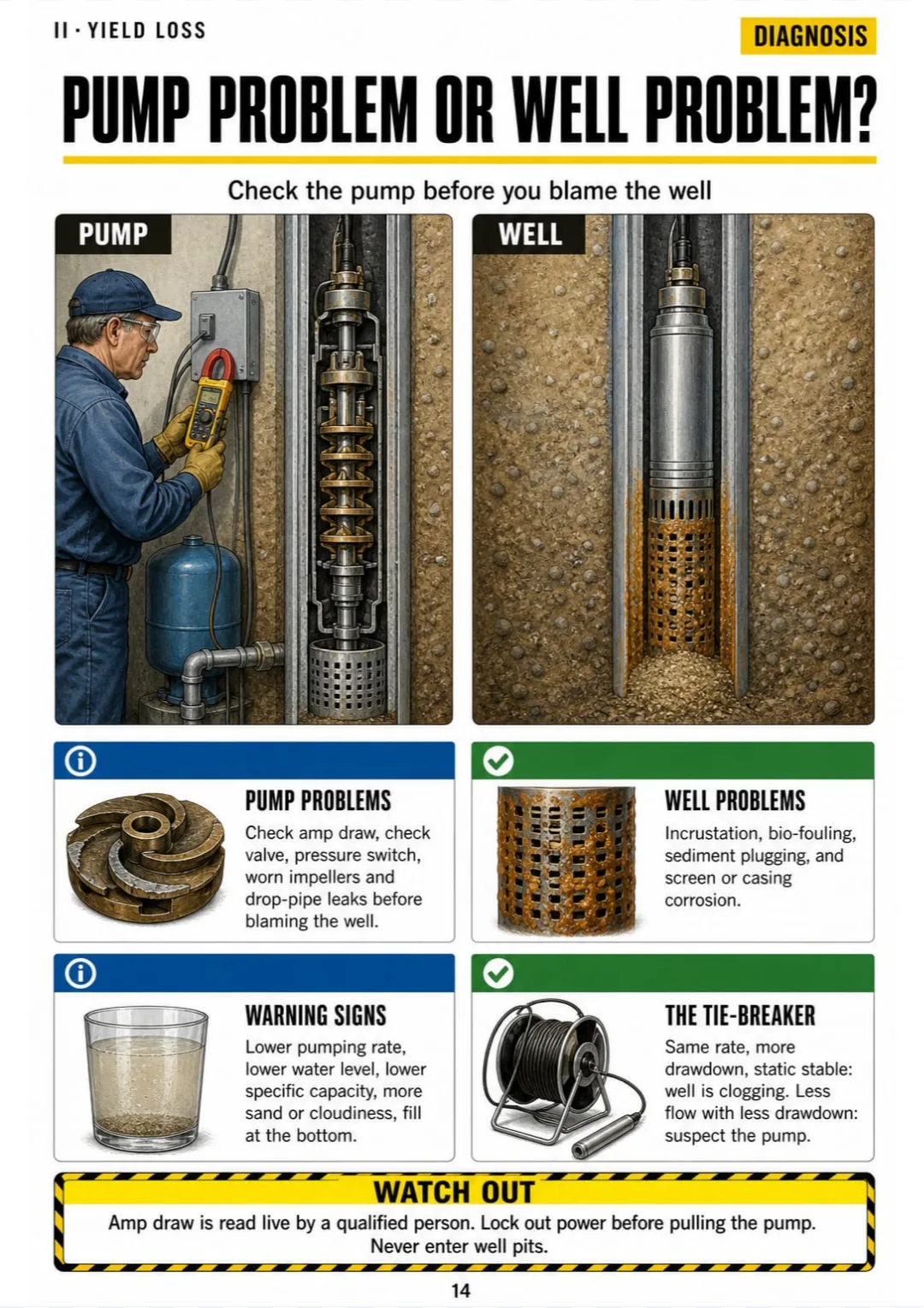
Pump or well? Static level and drawdown tell you which one lost the yield.
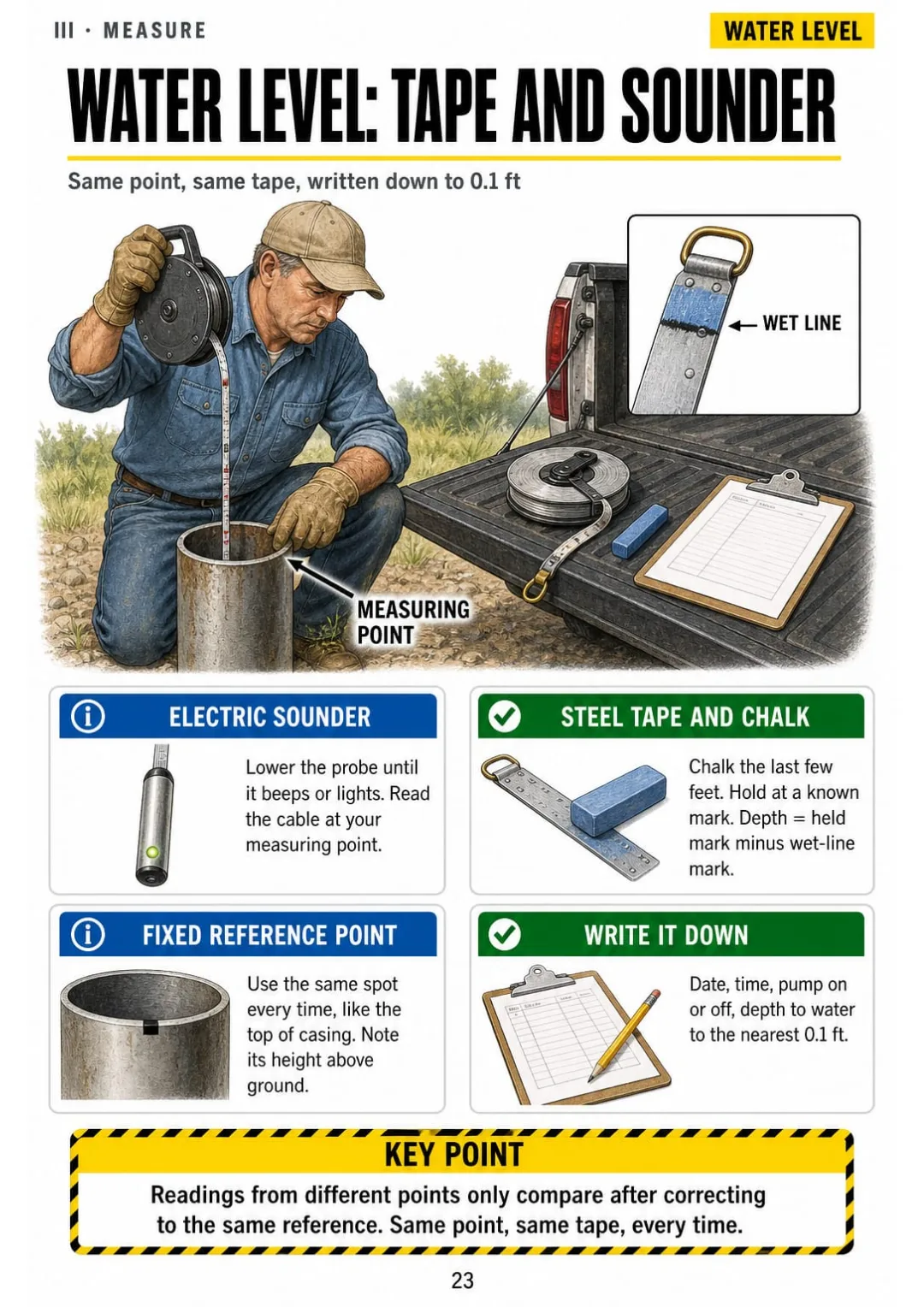
Sounder or chalked steel tape, read from the top of casing, logged to 0.1 ft
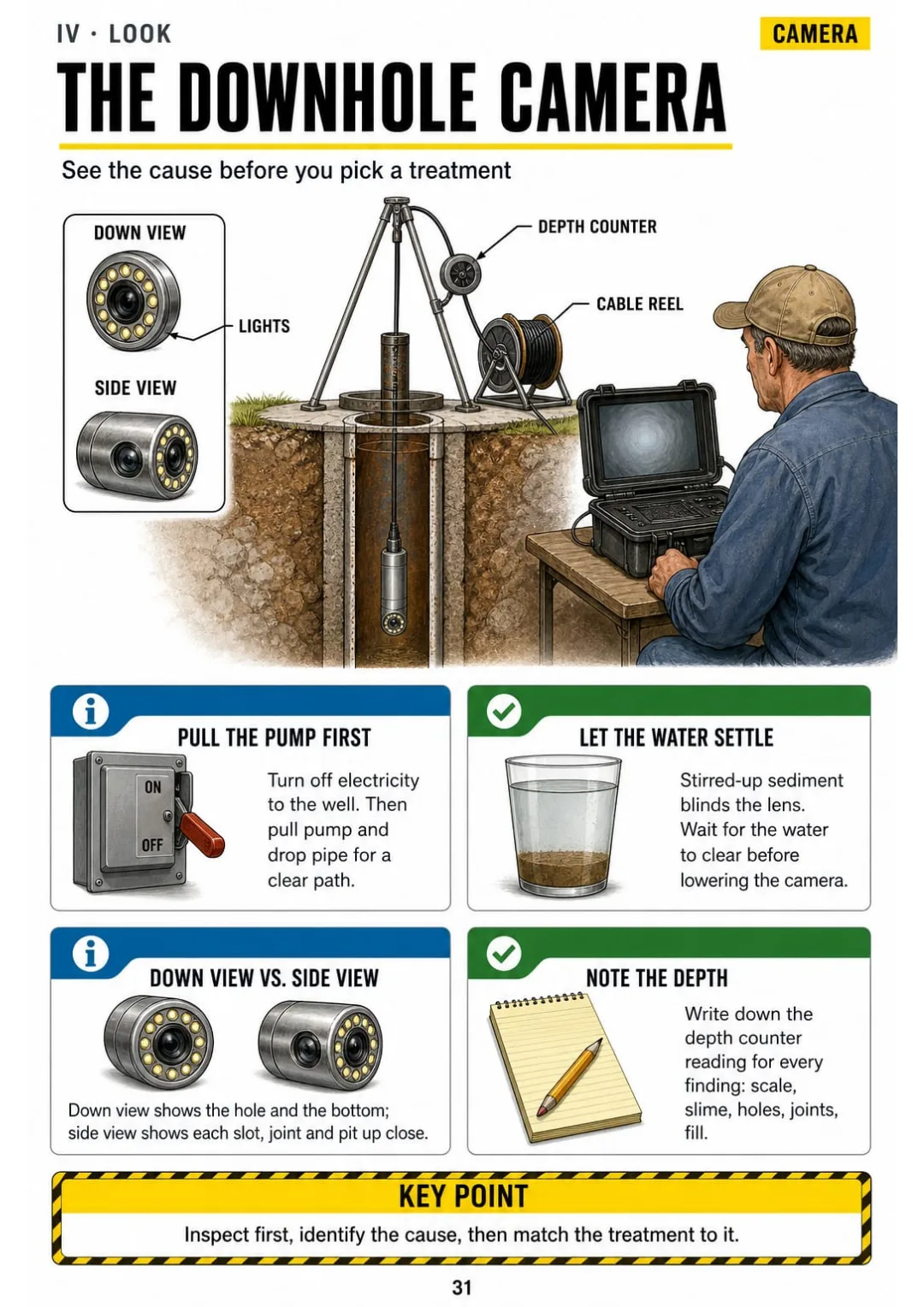
Down view, side view and depth counter: the camera tells you what to treat.
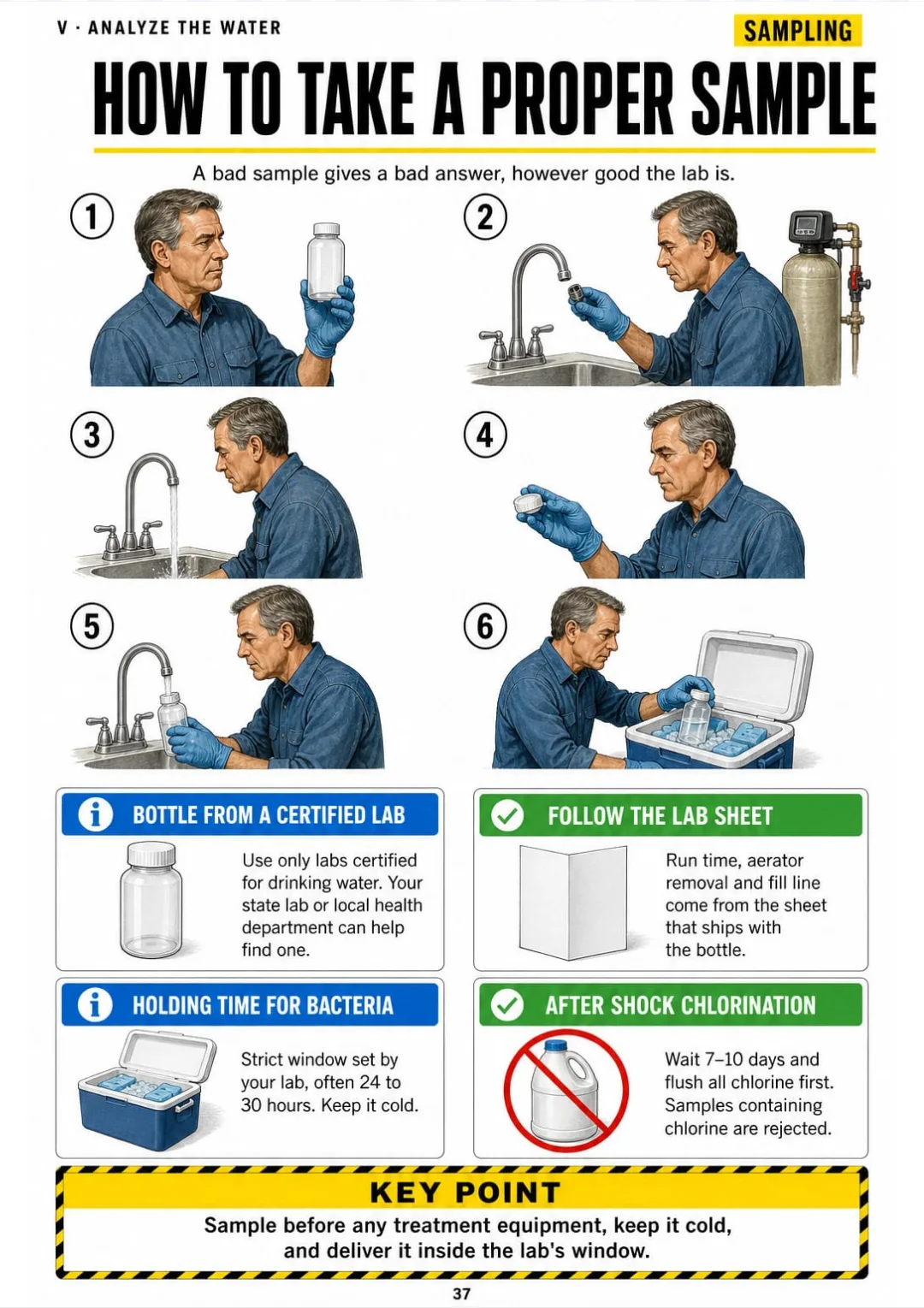
Certified lab bottle, no chlorine, kept cold, delivered within the lab's window, often 24–30 hours.
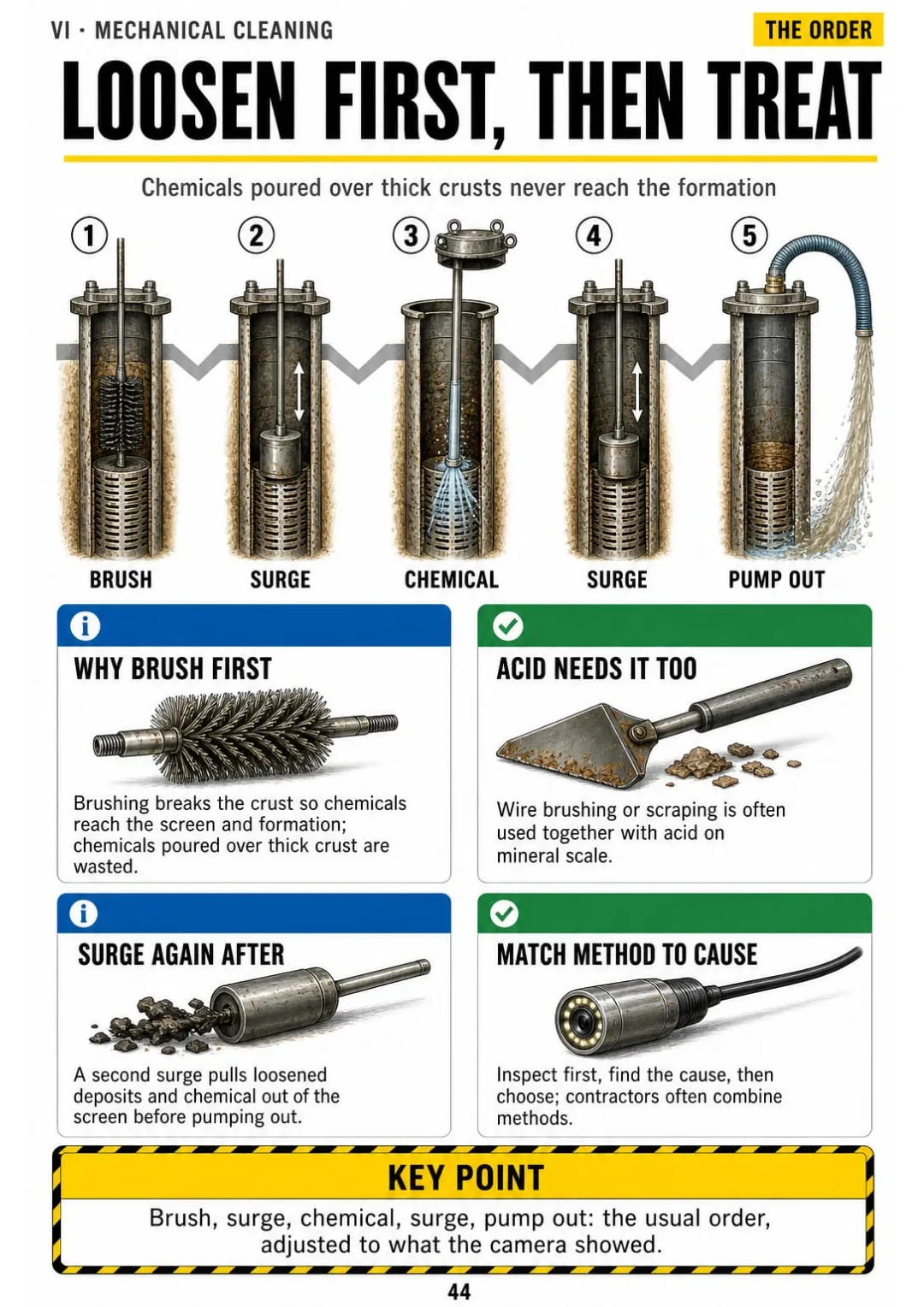
The rehab order: brush → surge → chemical → surge → pump out.
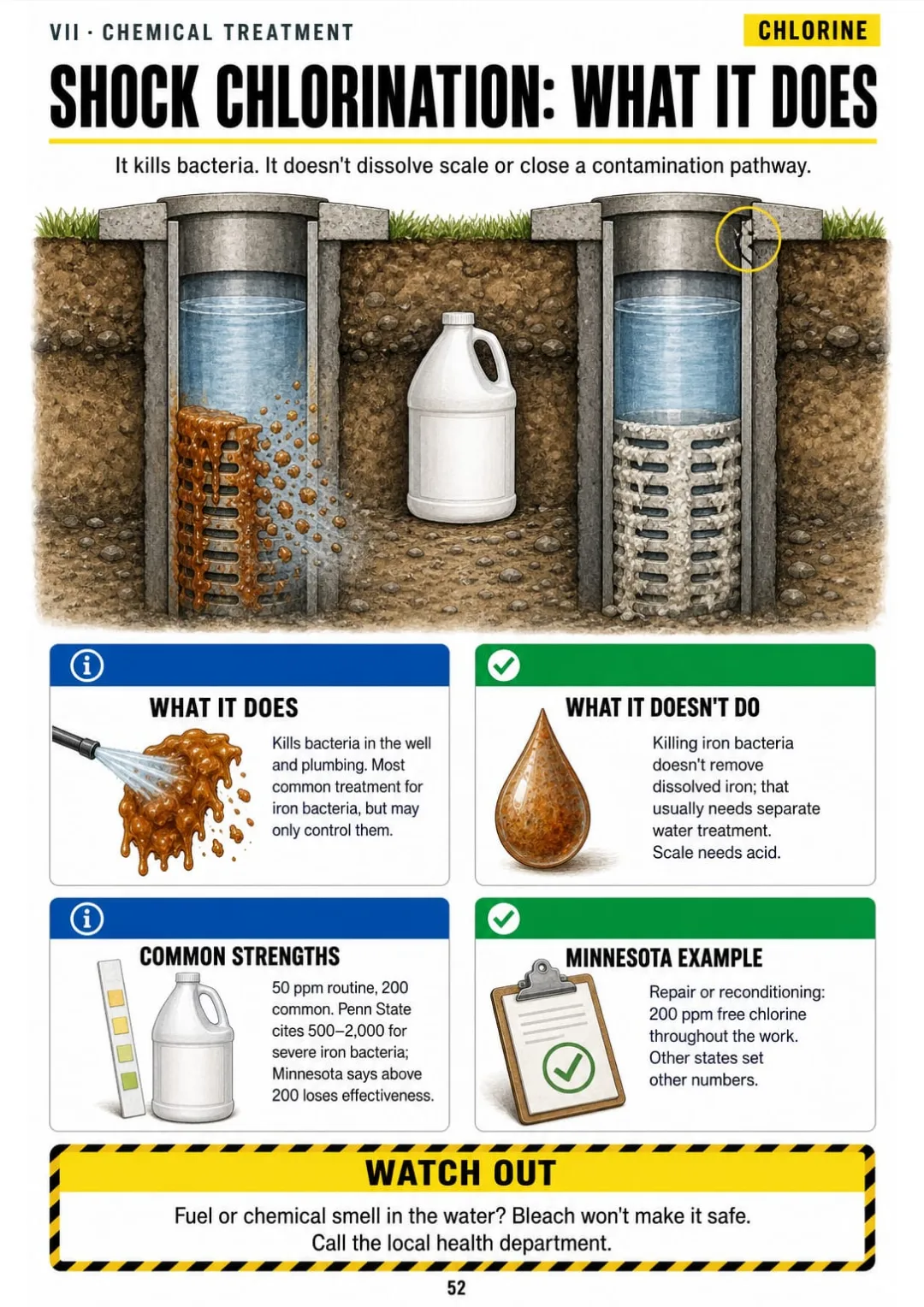
Shock chlorination: 50–200 ppm is the common range; it kills bacteria but won't dissolve scale or seal a crack.
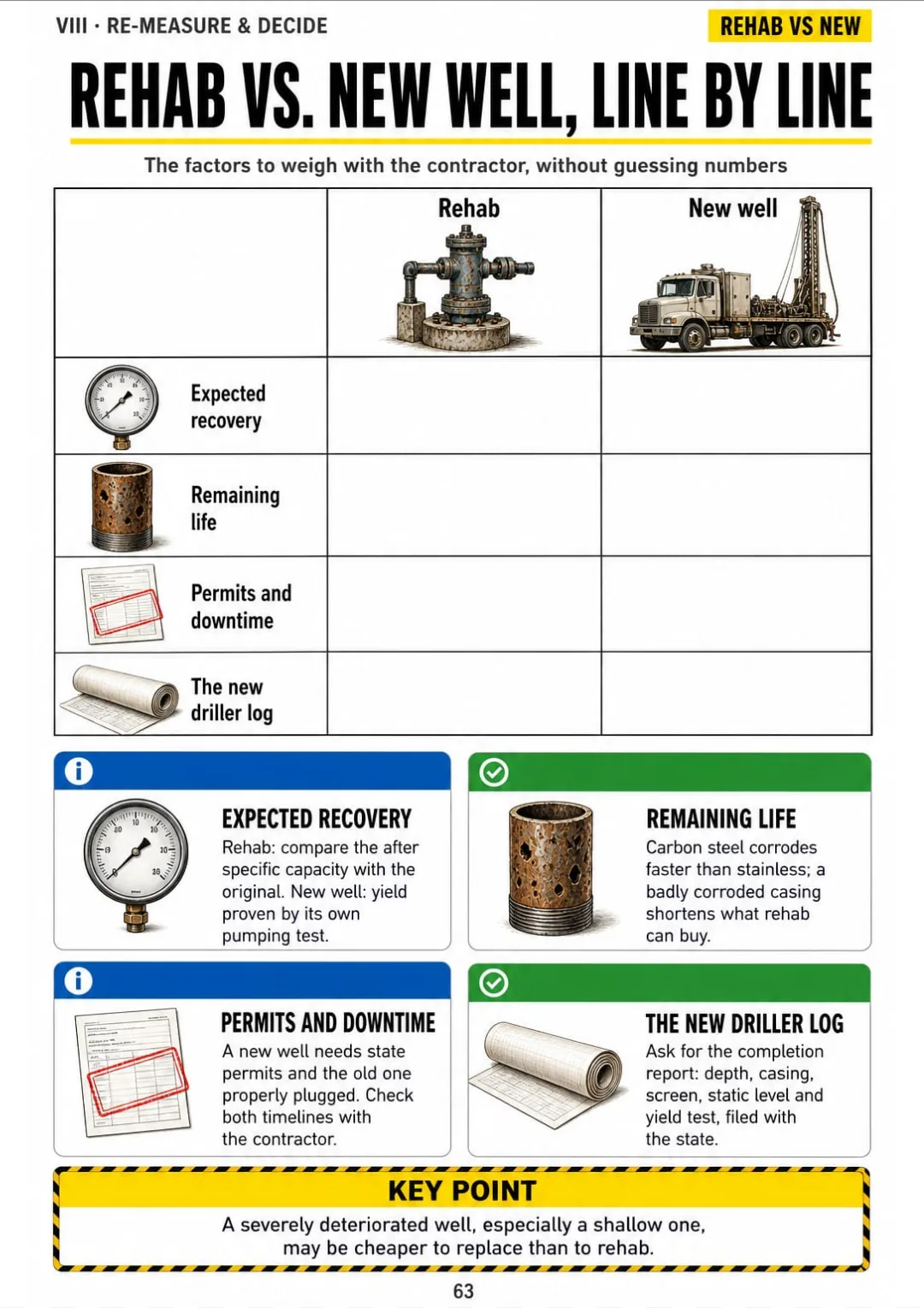
Five lines to weigh: recovery, remaining life, permits, downtime and the new driller log.

Swipe to see more →

These are real pages from the book. The table of contents is the full one: 9 parts and 67 topics.

The Problem Isn't You. It's How It Was Explained to You.

You're at the wellhead with the cap off and a sounder in your hand. The owner asks how far down the water is, and the reading changes every time you lower the probe.

The manual covers it in three paragraphs: reference point, wet casing, cascading water, tape stretch. All words, and nothing that shows you where to read from.

Sounder or chalked steel tape, read from the top of casing, logged to 0.1 ft

In the book, that same reading is one page: the sounder and the chalked steel tape drawn side by side, read from the top of casing and logged to 0.1 ft, with static and pumping level marked on the cutaway.

Specific capacity, the step-drawdown test, the downhole camera, shock chlorination in gallons and ppm: each one has its own page, drawn the same way.

You take the reading, write it down and know what it means for the well. No going back to the manual.

COMPARE FOR YOURSELF

Same Topic, Two Ways to Learn It

THIS
  • The manual: line after line
  • Pump vs. well diagnosis explained only in words
  • You show up to the job still unsure
When a decline in well yield is reported, the investigator must first determine whether the reduction is attributable to the pumping equipment or to the well itself. This determination requires comparison of the current static water level and pumping water level against values documented at the time of completion. A static level consistent with historical records, combined with increased drawdown at an equivalent discharge rate, generally indicates a loss of well efficiency resulting from encrustation or clogging of the screen and adjacent formation, rather than deficiencies in pump performance.
FOR THIS
  • Pump or well, in one drawing
  • Static level and drawdown in a box
  • You see it and you get it
Pump or well? Static level and drawdown tell you which one lost the yield.
CONTENTS

Take a Look at the 9 Parts and 67 Topics

How a working well works, why it loses yield, the 5 steps (measure, look, analyze the water, clean, re-measure and decide) and a quick review at the end: 72 pages, all illustrated.

IHow a Working Well Works · pp. 6-13
  1. The well in cutaway
  2. Static level vs. pumping level
  3. The cone of depression
  4. Screen, slot size and gravel pack
  5. Bedrock wells vs. screened wells
  6. Well volume per foot of casing
  7. Yield, gpm and household demand
  8. The 5-step order: measure, look, analyze, clean, re-measure
IIWhy a Well Loses Yield · pp. 14-22
  1. Pump problem or well problem?
  2. Iron bacteria and biofilm
  3. Sulfate-reducing bacteria and rotten-egg odor
  4. Mineral scale: carbonate, iron and manganese
  5. Sand, silt and fines
  6. Corrosion and a broken casing or screen
  7. Overpumping and pump set too low
  8. Falling water table vs. clogged well
  9. How fast each problem builds
IIIStep 1: Measure · pp. 23-30
  1. Measuring water level: tape and sounder
  2. Specific capacity: the one number to track
  3. When to start rehab: the percentage rule
  4. Measuring flow rate: bucket, meter, orifice
  5. The step-drawdown test
  6. The constant-rate pumping test
  7. Recovery test
  8. Finding the original well record
IVStep 2: Look · pp. 31-36
  1. The downhole camera: what it shows
  2. Clean, scaled, slimed: side by side
  3. Corroded, holed or collapsed casing
  4. Sediment fill at the bottom
  5. Checking the wellhead and surface seal
  6. Inspecting the pulled pump and drop pipe
VStep 3: Analyze the Water · pp. 37-43
  1. How to take a proper water sample
  2. Iron and manganese numbers
  3. Hardness, pH and scaling tendency
  4. Total coliform and E. coli
  5. Testing for iron and sulfur bacteria
  6. Reading the lab report
  7. From results to cause: the decision table
VIStep 4: Mechanical Cleaning · pp. 44-51
  1. Why mechanical comes before chemical
  2. Wire brushing the casing and screen
  3. Surging with a surge block
  4. Air-lift pumping and surging
  5. High-velocity jetting
  6. Bailing out the sediment fill
  7. Hydrofracturing in bedrock wells
  8. Mechanical cleaning safety
VIIStep 4: Chemical Treatment · pp. 52-59
  1. Shock chlorination: what it does and doesn't do
  2. Chlorine dose in gallons and ppm
  3. Mixing and circulating the chlorine
  4. Flushing and disposing of chlorinated water
  5. Acid treatment for mineral scale
  6. Never mix chlorine and acid
  7. Biodispersants and surfactants
  8. Chemical safety and PPE
VIIIStep 5: Re-measure and Decide · pp. 60-67
  1. The after test: same rate, same timing
  2. Retesting the water after rehab
  3. Rehab, redrill or plug: the decision chart
  4. Comparing rehab and new well, line by line
  5. Liners and screen replacement
  6. Plugging an abandoned well
  7. Preventive maintenance schedule
  8. Explaining the job to the owner or helper
IXReview and Quick Check · pp. 68-72
  1. Most frequent rehab mistakes
  2. Symptom to first check: one page
  3. Numbers to keep at hand
  4. Job day checklist
  5. What to verify with your state

One Page, One Topic, All Clear

Think of it this way:

You're on a call. The well made 10 gpm when it was drilled, now it makes 4, and you need to know if it's the pump or the well before you pull anything.

You open the page on pump problem or well problem: the cutaway shows static level and drawdown side by side. Same static level, more drawdown at the same rate? It's the well, not the pump.

Certified lab bottle, no chlorine, kept cold, delivered within the lab's window, often 24–30 hours.

Same with specific capacity, iron bacteria and biofilm, the downhole camera, surging with a surge block and the chlorine dose: each one on its own page.

Well Rehabilitation Illustrated is 9 parts and 67 topics, all drawn, with a quick-check review at the end: frequent mistakes, numbers to keep at hand and a job day checklist.

What you see drawn, you don't have to memorize.

What's Inside Well Rehabilitation Illustrated:

Ipp. 6-13

How a Working Well Works

The well in cutaway, static vs. pumping level, the cone of depression, screen and gravel pack, bedrock vs. screened wells, gallons per foot of casing and the 5-step order.

IIpp. 14-22

Why a Well Loses Yield

Pump or well, iron bacteria and biofilm, rotten-egg odor, carbonate, iron and manganese scale, sand and fines, corrosion, overpumping and a falling water table.

IIIpp. 23-30

Step 1: Measure

Tape and sounder, specific capacity, when to start rehab, measuring flow, the step-drawdown, constant-rate and recovery tests, and finding the original well record.

IVpp. 31-36

Step 2: Look

What the downhole camera shows, clean vs. scaled vs. slimed side by side, damaged casing, sediment fill, the wellhead seal and the pulled pump.

Vpp. 37-43

Step 3: Analyze the Water

Taking a proper sample, iron and manganese, hardness and pH, coliform and E. coli, bacteria tests, reading the lab report and the results-to-cause table.

VIpp. 44-51

Step 4: Mechanical Cleaning

Why mechanical comes first, wire brushing, surging with a surge block, air lift, jetting, bailing, hydrofracturing in bedrock and job safety.

VIIpp. 52-59

Step 4: Chemical Treatment

Shock chlorination, the dose in gallons and ppm, mixing, flushing and disposal, acid for scale in general terms, never mixing chlorine and acid, and PPE.

VIIIpp. 60-67

Step 5: Re-measure and Decide

The after test, retesting the water, the rehab-redrill-plug chart, liners and screens, plugging an old well, a maintenance schedule and explaining the job.

IXpp. 68-72

Review and Quick Check

Most frequent mistakes, symptom to first check, numbers to keep at hand, a job day checklist and what to verify with your state.

At the end of the book: A review part with the most frequent rehab mistakes, a symptom-to-first-check page, numbers to keep at hand and a job day checklist.
Plus: 2 Free Books

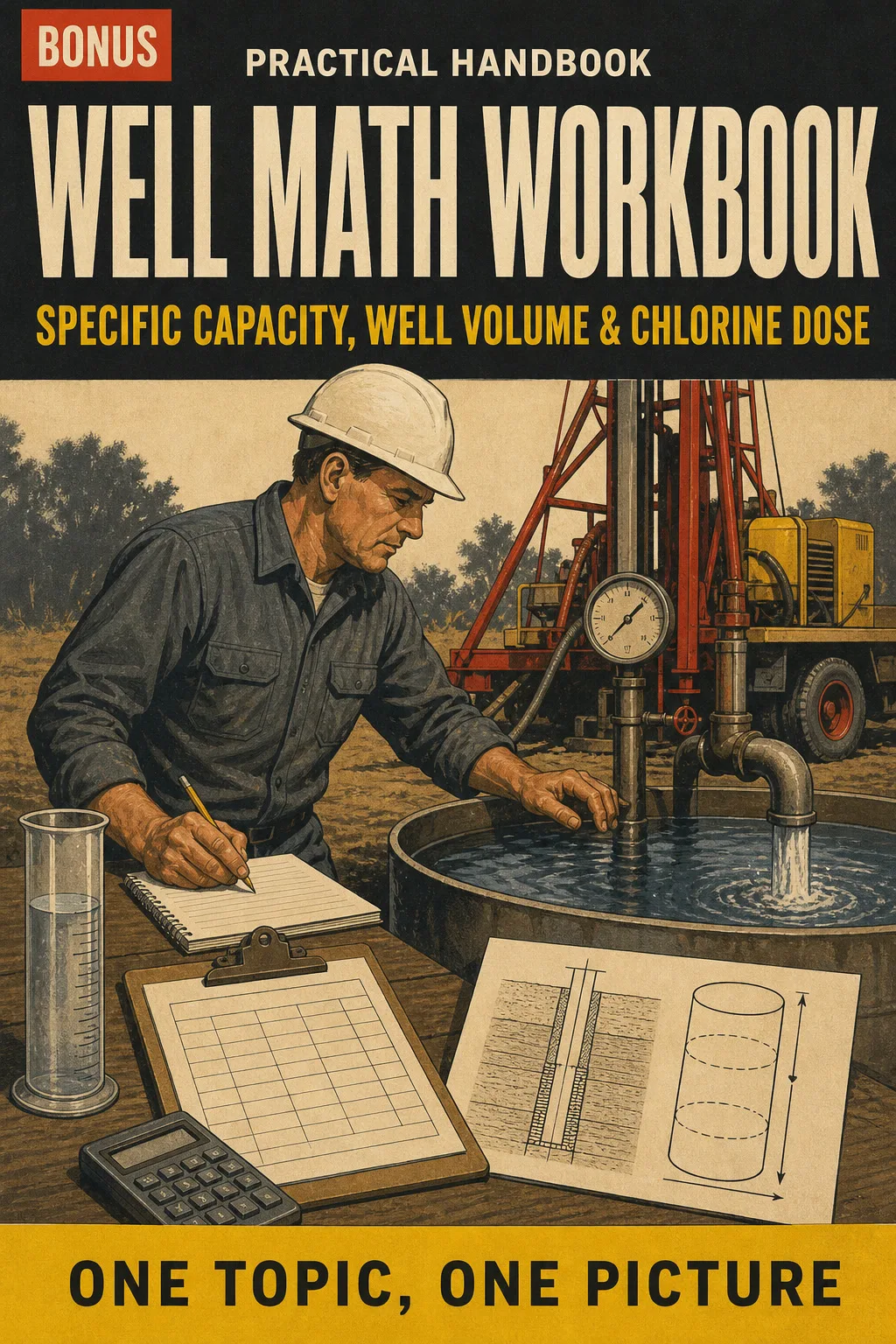
Well Math Workbook: Specific Capacity, Well Volume & Chlorine Dose

BONUS 1: «Well Math Workbook: Specific Capacity, Well Volume & Chlorine Dose»

Value on its own: US$ 17.90

Practice the three numbers every rehab job needs, gallons in the well, gpm per foot of drawdown and the chlorine dose in ppm, with worked problems and answers.

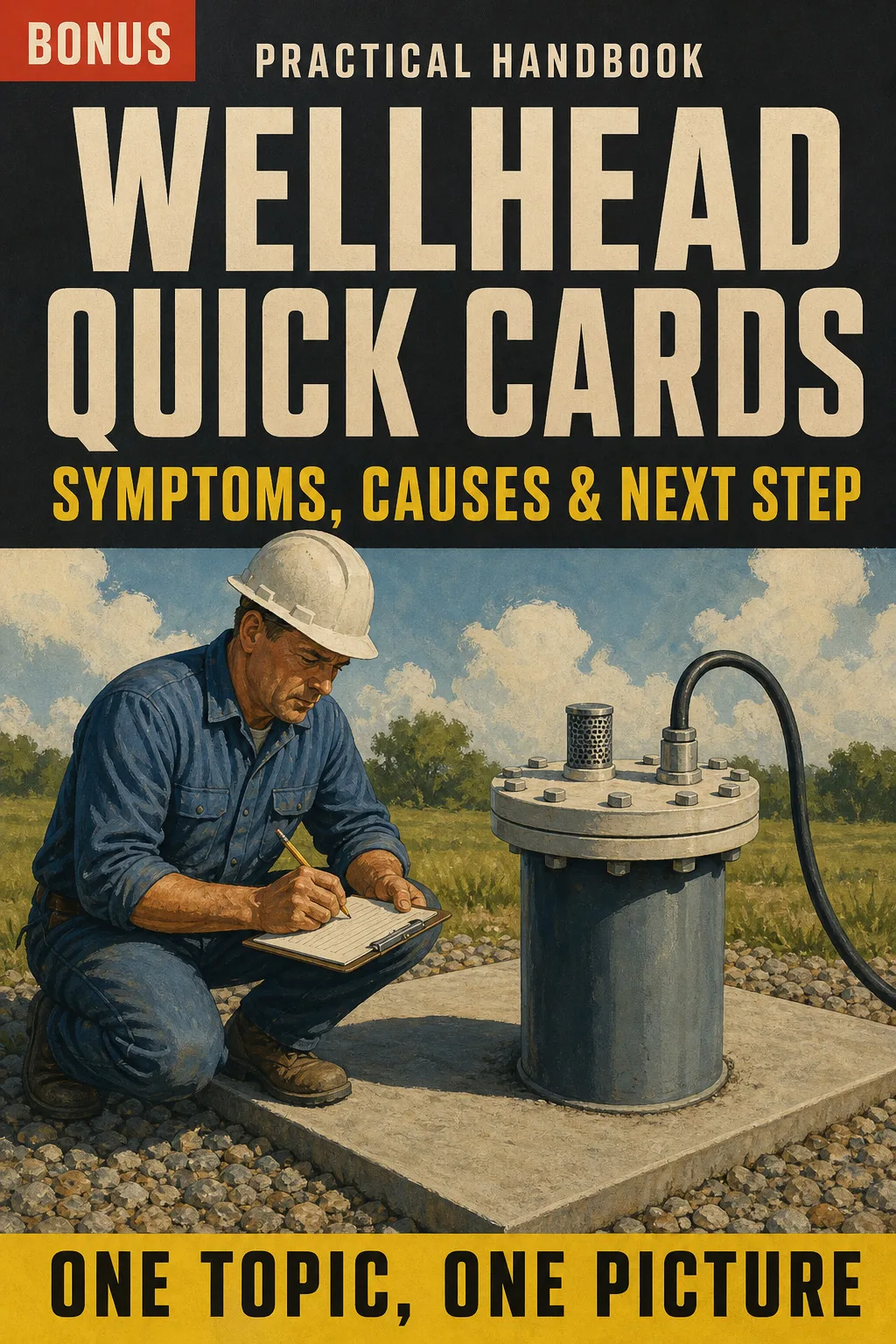
Wellhead Quick Cards: Symptoms, Causes & Next Step

BONUS 2: «Wellhead Quick Cards: Symptoms, Causes & Next Step»

Value on its own: US$ 14.90

One printable card per symptom (red water, slime, odor, sand, falling flow) with the likely cause and what to check next, to keep in the truck.

Well Rehabilitation Illustrated with 2 Free Books

  • Well Rehabilitation Illustrated: 72 illustrated pagesUS$ 63
  • BONUS 1: Well Math Workbook: Specific Capacity, Well Volume & Chlorine DoseUS$ 17.90
  • BONUS 2: Wellhead Quick Cards: Symptoms, Causes & Next StepUS$ 14.90
  • High-resolution PDF to printIncluded
Total value US$ 95.80
YOUR PRICE:
US$ 27
You save US$ 68.80
YES, I WANT WELL REHABILITATION ILLUSTRATED FOR US$ 27

📄 This is a digital PDF book sent to your email: nothing is printed or shipped.

Secure purchaseEncrypted payment30-day guarantee

PDF by email: We email you Well Rehabilitation Illustrated as a PDF, together with the two free books. It's a single payment: no installments, no extra charges.

Who This Book Is For

You're new on a well crew

You're new on a well crew

Casing, screen, pumping level, surge block, air lift: each one drawn on its own page, so you know what the boss is doing and why.

You've got a rehab job this week

You've got a rehab job this week

Measure, look, analyze, clean, re-measure in the same order, with specific capacity and the chlorine dose worked out in gpm, feet, gallons and ppm.

You've been drilling for years

You've been drilling for years

The whole process laid out in drawings you can show the owner or your helper, plus the rehab, redrill or plug chart to back up the call.

Everything You Get Today

US$ 95.80US$ 27
YES, I WANT WELL REHABILITATION ILLUSTRATED FOR US$ 27

📄 This is a digital PDF book sent to your email: nothing is printed or shipped.

30DAYS
GUARANTEE

30-Day Guarantee

Try Well Rehabilitation Illustrated for 30 days, bonus books included.

We refund everything if the file won't open, if the book isn't what you see here, if you were charged twice or if the email doesn't arrive. Just email us.

You pay once. No subscriptions.

Frequently Asked Questions

Is it for me if I already work on wells, or is it for beginners?

Both. Each page starts with the basics and gets to the working number: gpm per foot, gallons in the casing, ppm. A helper learns the job; a driller gets the process in order and drawn to show the owner.

Where does the content come from?

From the AWWA A100 water well standard, US EPA private well guidance and secondary drinking water standards, and state well construction and abandonment codes. Anything that changes by state is flagged to verify with your state agency.

Is it official material?

No. It's an independent illustrated study book. It isn't issued, approved or endorsed by any agency or association.

Does it replace training, a license or a contractor?

No. It helps you understand and organize the work. It doesn't replace hands-on training, state licensing, product labels or a certified lab, and it doesn't come with a certificate or continuing education credits. Acid treatment is covered only in general terms, as work for trained crews.

Are the practice problems from a licensing exam?

No. The worked problems in the workbook are written for this book. They aren't official questions from any exam.

When and how do I get it?

The book and the 2 bonus books come as PDFs by email, to the address you enter at checkout.

Do I have to pay every month?

No. It's a one-time payment. No subscription.

Can I have it on paper?

Yes. The PDFs print fine at home or at a print shop, so you can keep a copy in the truck.

How does the refund work?

You have 30 days. We refund everything if the file won't open, if the book isn't what you see on this page, if you were charged twice or if the email doesn't arrive: just email us.

Before You Close This Page

No more rereading with nothing sticking.

Specific capacity: one drawing and you've got it.

You get to the wellhead knowing where everything is.

Drawings make studying faster.

The book is right below.

One-time payment: US$ 27 · Guarantee: 30 days · PDF by email

YES, I WANT WELL REHABILITATION ILLUSTRATED FOR US$ 27

📄 This is a digital PDF book sent to your email: nothing is printed or shipped.